EcoFlow DELTA 2 Max vs Anker SOLIX S2000 Power Stations
Updated · Price Drop Radar
Bottom line
Both hold about 2kWh, but they are built for different jobs. The Anker SOLIX S2000 is the better pick for indoor home backup: it is 15 pounds lighter, uses less power at idle and costs much less per watt-hour at recent Amazon prices. Choose the EcoFlow DELTA 2 Max if you need more than 1,500W at once, fast solar charging or room to add batteries later.

EcoFlow DELTA 2 Max
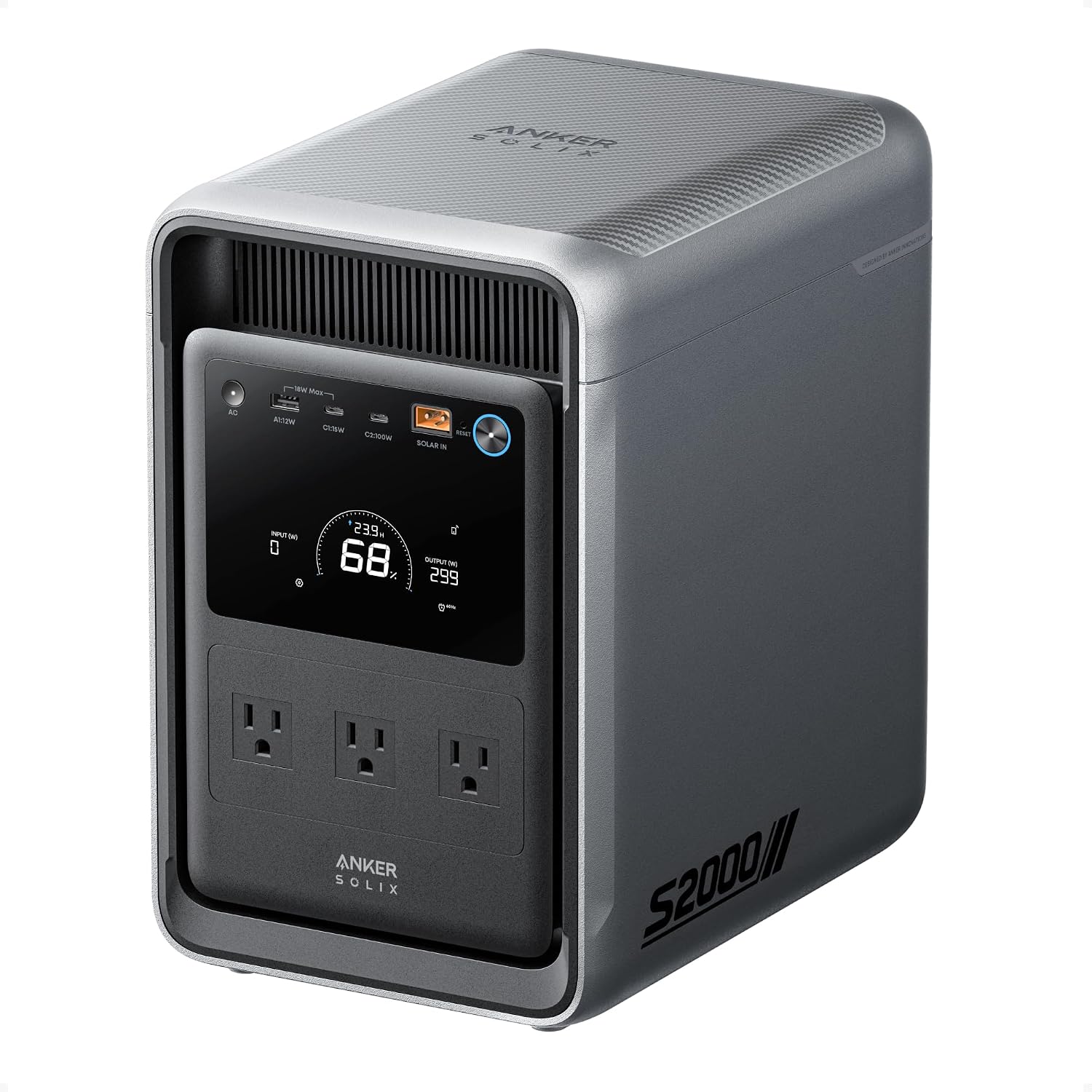
Anker SOLIX S2000
Side by side
| Spec | EcoFlow DELTA 2 Max | Anker SOLIX S2000 |
|---|---|---|
| Battery capacity [1][2] | 2,048Wh LFP | 2,010Wh LFP |
| Continuous AC output [1][2][5] | 2,400W (X-Boost up to 3,400W) | 1,500W (3,000W peak) |
| Wall recharge [4][2] | 0 to 80% in about 1.1 hours | About 2.3 hours by default; 1,600W UltraFast mode in the app |
| Max solar input [1][2] | 1,000W | 400W |
| Rated battery life [1][2] | 3,000 cycles to 80% | 10,000 cycles to 60% |
| Weight [4][2] | About 50.7 lb (23 kg) | 35.7 lb |
| Idle power draw [2] | Not listed on EcoFlow's product page | 6W with the inverter on, 2W standby |
| Expandable [1][3] | Yes, to 6,144Wh with two extra batteries | No |
| Warranty [1][2] | 5 years | 5 years |
EcoFlow DELTA 2 Max
- 2,400W continuous output runs bigger appliances
- 1,000W solar input recharges far faster off-grid
- Can grow to about 6kWh with extra batteries
- Heavy at about 51 lb
- Costs more per watt-hour at recent prices
Anker SOLIX S2000
- Much smaller and 15 lb lighter for the same capacity
- Very low idle draw, so a fridge runs longer
- Rated for far more charge cycles
- 1,500W limit rules out some kitchen appliances
- Only 400W of solar input
- No 12V DC port and no expansion
Which one is right for you
| If you are | Pick | Why |
|---|---|---|
| Apartment or house backup for a fridge, router and phones | Anker SOLIX S2000 | Smaller, lighter, lower idle draw, rated for more cycles |
| Running a window AC, power tools or kitchen appliances | EcoFlow DELTA 2 Max | 2,400W continuous output |
| Off-grid cabin or RV with solar panels | EcoFlow DELTA 2 Max | 1,000W solar input and expandable to about 6kWh |
| Tight budget per watt-hour | Anker SOLIX S2000 | Cheaper per watt-hour at recent Amazon prices |
What to look for
Continuous output, not peak
Why it matters: Continuous watts decide what can run for more than a moment. Peak or boost numbers only cover start-up surges or special modes.
How to check: Add up the wattage labels of what you want to run at the same time and compare it to the continuous rating.
Watch out: The S2000 tops out at 1,500W continuous, so anything that draws more than that will trip it. Check the label on the appliance.
Battery life rating
Why it matters: Cycle counts tell you how long the battery keeps its capacity.
How to check: Look at the percentage each brand measures to, not just the cycle count.
Watch out: These two are not measured the same way: EcoFlow quotes 3,000 cycles to 80% and Anker quotes 10,000 cycles to 60%.
Idle draw
Why it matters: A power station uses some of its own energy just being on. For long outages, that adds up.
How to check: Look for a published idle or standby figure.
Watch out: Anker publishes 6W idle; we didn't find an idle figure on EcoFlow's product page.
Solar input
Why it matters: If the grid is down for days, solar input decides how fast you refill.
How to check: Compare max solar watts and make sure your panels fit the voltage limits in the manual.
Watch out: The S2000's 400W solar limit means a full refill from the sun takes about 5 hours with 400W of panels, per The Solar Lab.
Traps and timing
- Don't compare the 3,400W X-Boost or 3,000W peak figures as if they were continuous output. Use 2,400W vs 1,500W.
- UltraFast charging on the S2000 has to be switched on in the Anker app; by default it charges at 1,150W.
- Anker's S2000 specs page says some details, such as outlet counts and voltage limits, were still unpublished when it was written. Check the manual before planning a solar setup.
- The S2000 has been discounted before: TechRadar reported it at about $650 in Amazon's Labor Day sale. If the current price is well above that, it may be worth waiting.
Before you check out
- Add up the continuous watts of everything you'll run at once.
- Decide if you need solar, and how many watts of panels.
- Check if you'll ever want to add batteries.
- Confirm you can lift it: about 51 lb vs 36 lb.
- Compare the live Amazon price to the cost per watt-hour shown on this page.
How we put this together
We don't test power stations in a lab. We compared the makers' published specs, the Amazon listings and independent reviews, all listed under Sources, and where they disagree we say so. Prices come from Amazon and are refreshed by our system throughout the day.
Price Drop Radar earns a commission on qualifying Amazon purchases made through links on this page, at no extra cost to you. That never decides which product we recommend.
Quick answers
Can the Anker SOLIX S2000 run a refrigerator?
Yes. The Solar Lab measured about 33 hours on a fridge in its testing, and Anker says up to 35 hours depending on the fridge.
Is the EcoFlow DELTA 2 Max expandable?
Yes. EcoFlow says you can add up to two DELTA 2 Max Smart Extra Batteries for a total of 6,144Wh.
Which charges faster from the wall?
EcoFlow lists 0 to 80% in about 1.1 hours on AC. Anker lists about 2.3 hours by default and offers a 1,600W UltraFast mode; The Solar Lab measured a full AC charge in about 1 hour 47 minutes.
Does the S2000 have a car outlet?
No. Anker's Amazon listing states it has no 12V DC port.
Sources
- DELTA 2 Max product page, EcoFlow
- Anker SOLIX S2000 official specs and FAQ, Anker SOLIX
- Anker SOLIX S2000 review, The Solar Lab
- EcoFlow DELTA 2 Max listing, Amazon
- Anker SOLIX S2000 listing, Amazon
- Anker's S2000 dropped to $650 in Amazon's Labor Day sale, TechRadar